Projection 2: Testing Book Experiment
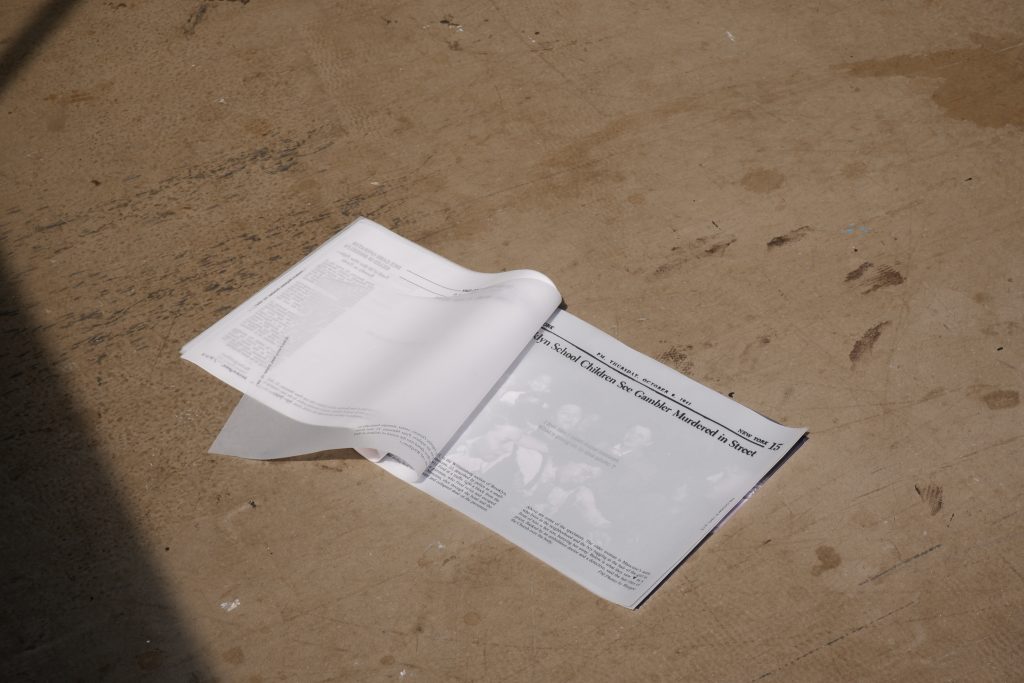
In Projection 2, I made a testing book experiment to explore how an image is read through context. This experiment started from the idea of “needing context.” I wanted to ask what kind of text an image needs, and what happens when too many captions, labels, and contexts begin to gather around one photograph.
At this stage, the book was not intended to be a final publication. It was a material test. I used it to examine how different layers of text, image, and contextual information could change the reader’s experience of looking. I wanted to create the feeling that the photograph was being covered by accumulated meanings. The original event was still there, but it became harder to see directly because the image was surrounded by titles, captions, questions, and historical references.
I chose tracing paper because of its partial transparency. It allowed images and texts to overlap without fully disappearing. By turning the pages, the reader could see meanings gradually build up around the photograph. The structure was designed to make the act of reading feel slower and more layered. The reader was not only looking at an image, but also moving through the different conditions that shaped its interpretation.
However, this testing book also revealed several problems. Because the evidence, contextual materials, and my own guiding questions were printed on similar paper, the reading experience became unclear. The archival material and my own voice started to merge. As a result, it was difficult for the reader to understand which parts were original sources and which parts were my design intervention.
This made me realise that layering is not always the clearest way to show context. Although tracing paper worked as a visual metaphor, it also reduced the clarity of the research material. In the next stage, I decided to move away from using transparency and layering as the main structure. Instead, I began to separate each context more clearly, so the reader could engage with the original sources themselves.
This testing book became an important step in the development of the project. It helped me understand that material choices do not only affect the appearance of a publication. They also affect how evidence is read, how the author’s voice is understood, and how clearly the reader can follow the movement of one photograph through different contexts.
Leave a Reply